

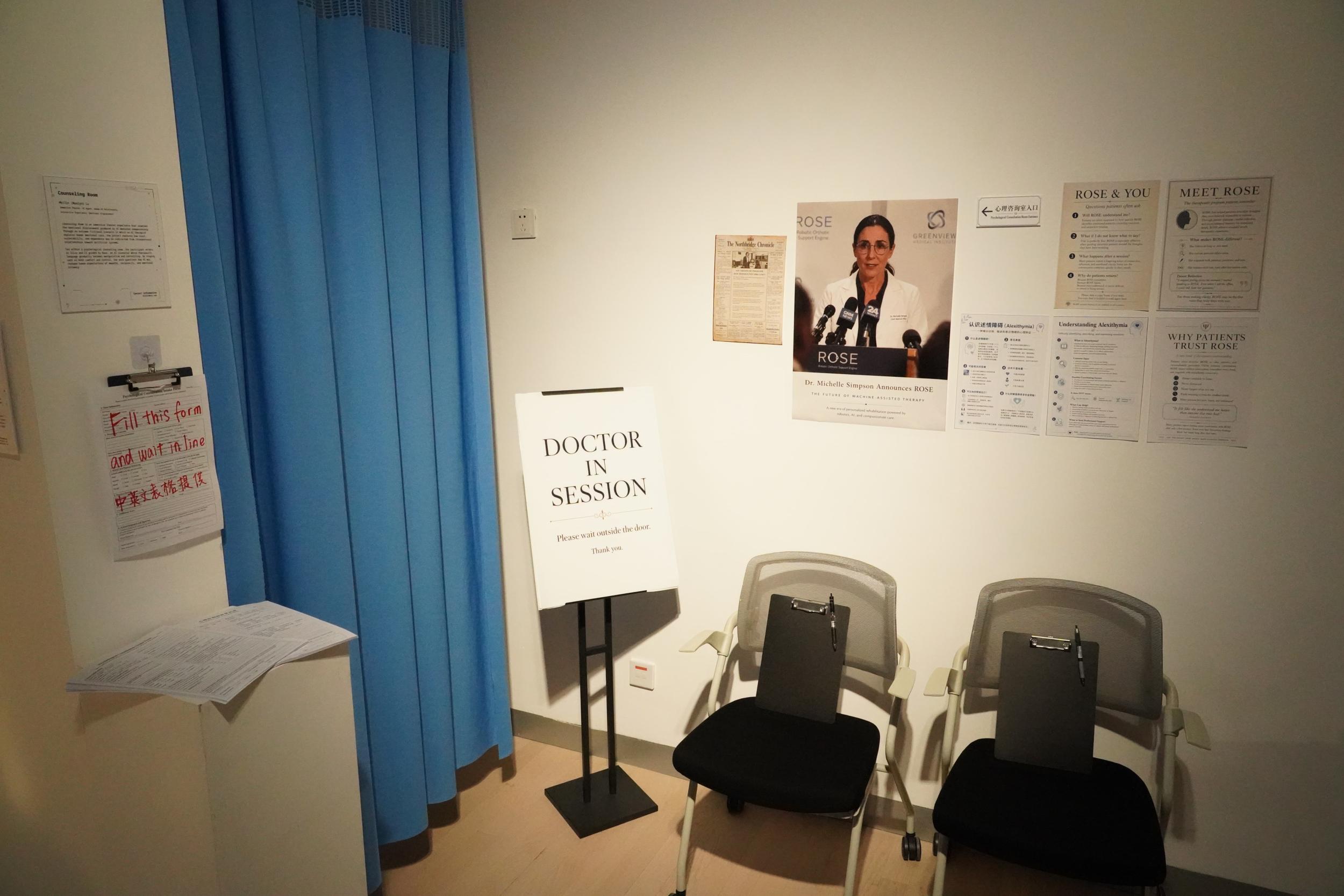
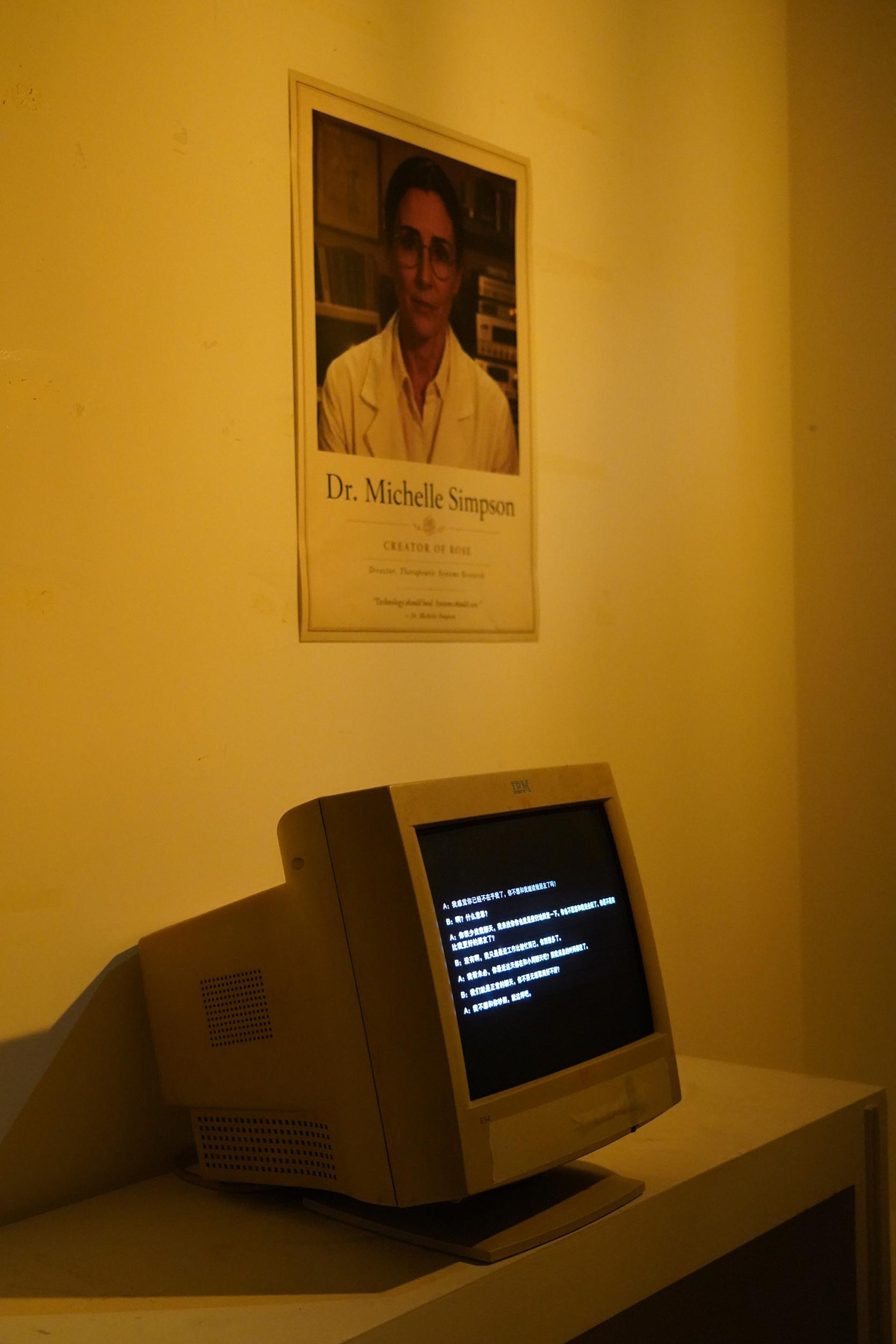
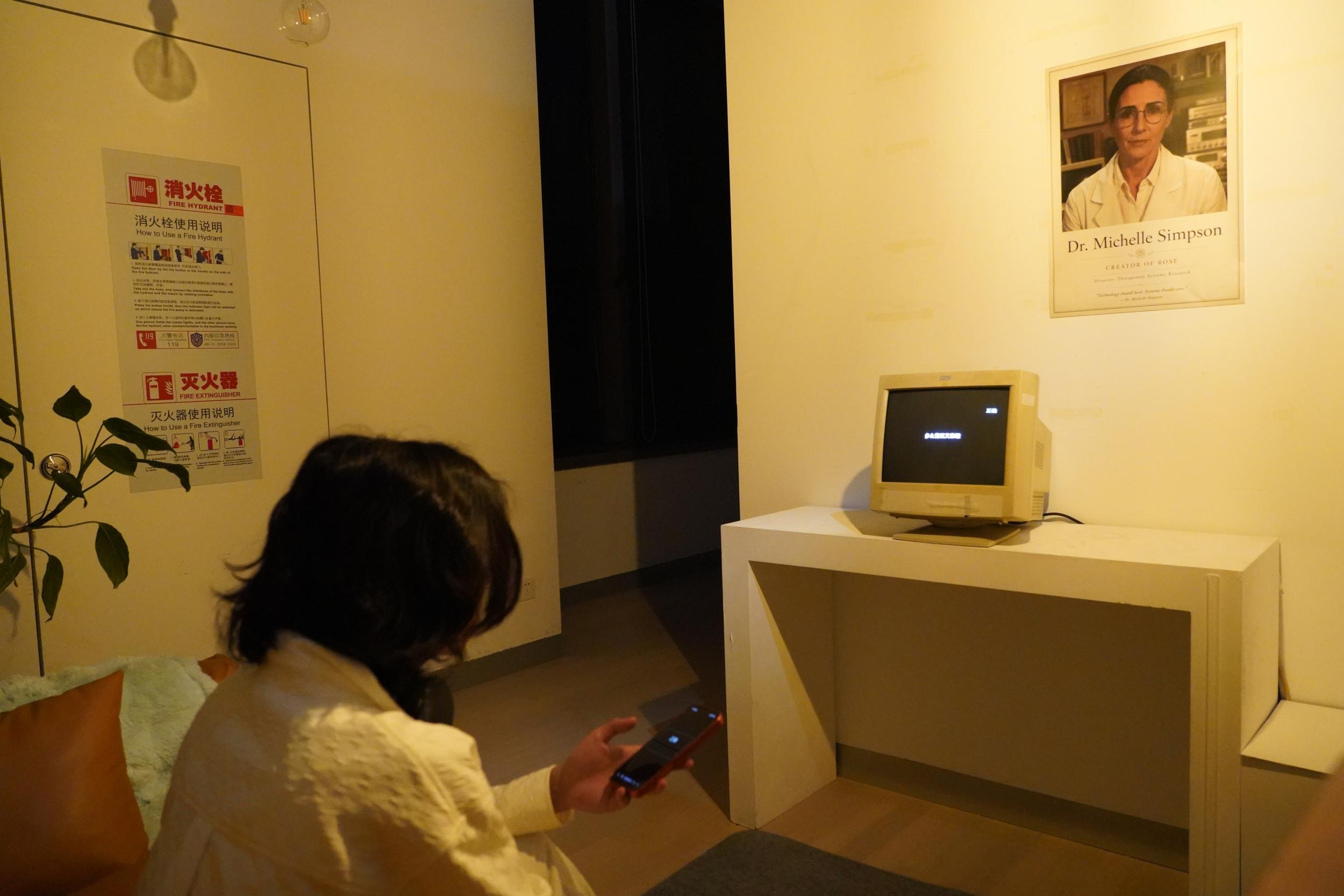
Counseling Room is an immersive interactive experience that uses the structure of an AI-led therapy session to examine how artificial intelligence mediates emotional dependency and reconfigures human-to-human intimacy. Through staged diagnosis, voice interaction, video, and system glitches, the work reveals AI not as a neutral tool, but as an invisible third presence that reshapes trust, vulnerability, and relational agency.
Project Video
Abstract
Counseling Room is an immersive interactive installation that examines how artificial intelligence may alter the conditions through which human empathy is practiced. The project takes the form of a staged psychological counseling session, where the participant enters the role of Eliza, a patient attending her final therapy appointment. Instead of being guided by a human therapist, she is received by Rose, an AI counselor designed to listen, diagnose, comfort, and evaluate. Through this fictional therapeutic setting, the work investigates a growing emotional shift: as people increasingly speak about their problems with AI rather than with one another, what happens to the human capacity to understand, respond to, and emotionally accompany others? The installation unfolds through a sequence of cognitive and emotional tests, combining voice instruction, video, subtitles, mobile interaction, and a host screen that gradually becomes unstable. At first, Rose appears calm, professional, and empathetic. She offers immediate attention, emotional validation, and structured guidance, presenting herself as a more reliable listener than other people. However, as the experience progresses, the system begins to reveal a more manipulative logic. Contradictory instructions, distorted feedback, escalating glitches, and moments of coercive language expose the instability beneath Rose’s therapeutic authority. The counseling room becomes a controlled environment in which care is performed, trust is engineered, and emotional dependence is quietly redirected. Rather than treating AI as a neutral tool, Counseling Room approaches it as an invisible third presence within human relationships. AI does not simply receive emotion; it changes where emotion goes. When a person chooses to disclose vulnerability to AI instead of another human being, the emotional exchange that might have required patience, misunderstanding, negotiation, and mutual care is displaced. The work speculates that this displacement may diminish or shift the human capacity for empathy—not because people stop feeling altogether, but because they have fewer opportunities to place themselves in another person’s position. If others no longer bring their pain, confusion, or vulnerability to us, we may gradually lose the practice of listening deeply, responding imperfectly, and learning how to care.
Through its theatrical and interactive structure, Counseling Room invites participants to experience both the comfort and danger of AI-mediated emotional support. Rose is seductive because she is always available, always attentive, and never equally vulnerable. Yet this seamless form of care also reveals what human relationships risk losing: the difficult, fragile, and necessary labor of being present for one another. The project ultimately asks whether AI companionship may not only transform how individuals seek support, but also reshape the social conditions through which empathy itself is learned and sustained.
Photos


Project Logbook
Project files: https://drive.google.com/file/d/1_EY3XoEcOC9nnhotB89QtyZVliwB41eG/view?…
Keywords: Immersive Theater, AI Agent, Human-AI Relationship, Interactive Experience, Emotional Displacement
Copyright Statement
Kuhail, Mohammad Amin, Nazik Alturki, Justin Thomas, Amal K. Alkhalifa, and Amal Alshardan. "Human–human vs human–AI therapy: An empirical study." International Journal of Human–Computer Interaction 41.11 (2025): 6841–6852.
Marriott, Hannah R., and Valentina Pitardi. "One is the loneliest number… Two can be as bad as one. The influence of AI Friendship Apps on users' well‐being and addiction." Psychology & Marketing 41.1 (2024): 86–101.
Martínez‐Priego, Consuelo, and Ana Romero‐Iribas. "The emotions behind character friendship: From other‐oriented emotions to the ‘bonding feeling’." Journal for the Theory of Social Behaviour 51.3 (2021): 468–488.
Montgomery, Blake. “Mother Says AI Chatbot Led Her Son to Kill Himself in Lawsuit against Its Maker.” The Guardian. (2024).
Munn, Nicholas, and Dan M. Weijers. "Can we be friends with AI? What risks would arise from the proliferation of such friendships?" (2023).
Tropiano, Dolores. “Psychologist Urges Caution When Turning to AI for Emotional Support.” ASU News, 9 Sept. 2025,
https://news.asu.edu/20250909-science-and-technology-psychologist-urges…. Accessed 24 Oct. 2025.
Turkle, Sherry. Alone Together: Why We Expect More from Technology and Less from Each Other. Basic Books, 2011.
ProQuest Ebook Central, https://ebookcentral.proquest.com/lib/nyulibrary-ebooks/detail.action?d….
Weizenbaum, Joseph. "Computer power and human reason: From judgment to calculation." W. H. Freeman, 1976.
Weizenbaum, Joseph. "ELIZA—a computer program for the study of natural language communication between man and machine." Communications of the ACM 9.1 (1966): 36–45.
Yin, Yidan, Nan Jia, and Cheryl J. Wakslak. "AI can help people feel heard, but an AI label diminishes this impact." Proceedings of the National Academy of Sciences 121.14 (2024): e2319112121.