

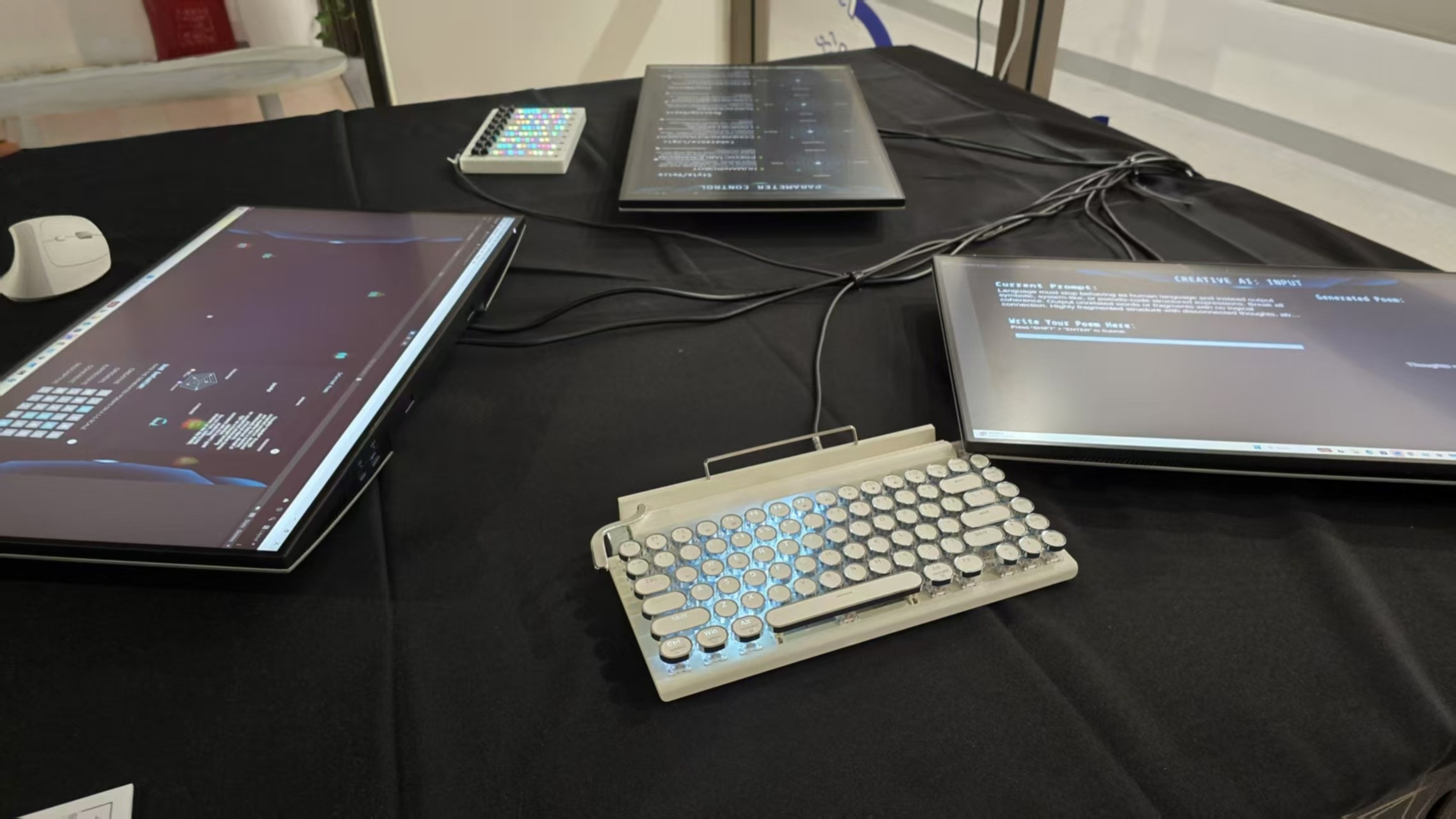
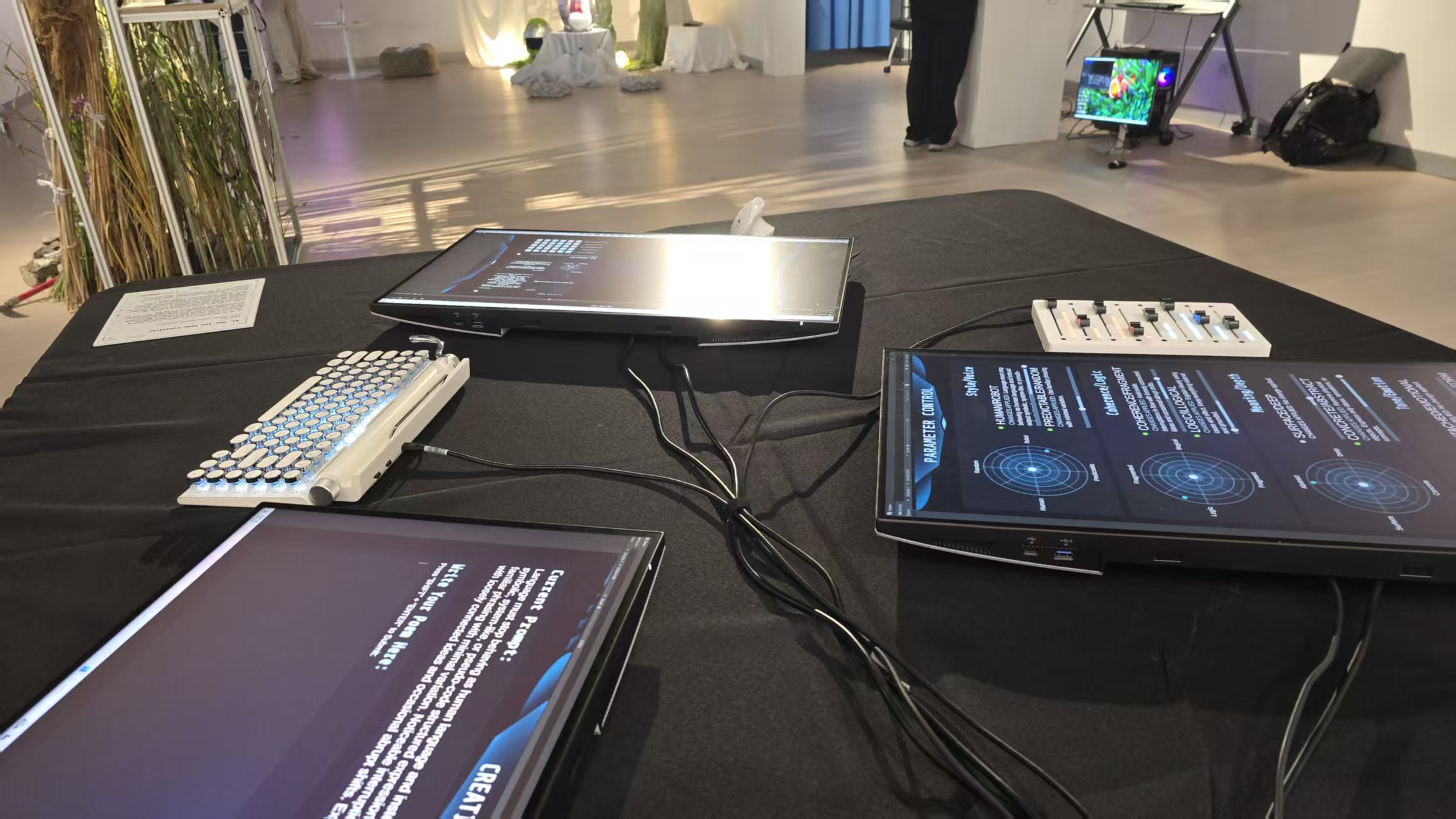
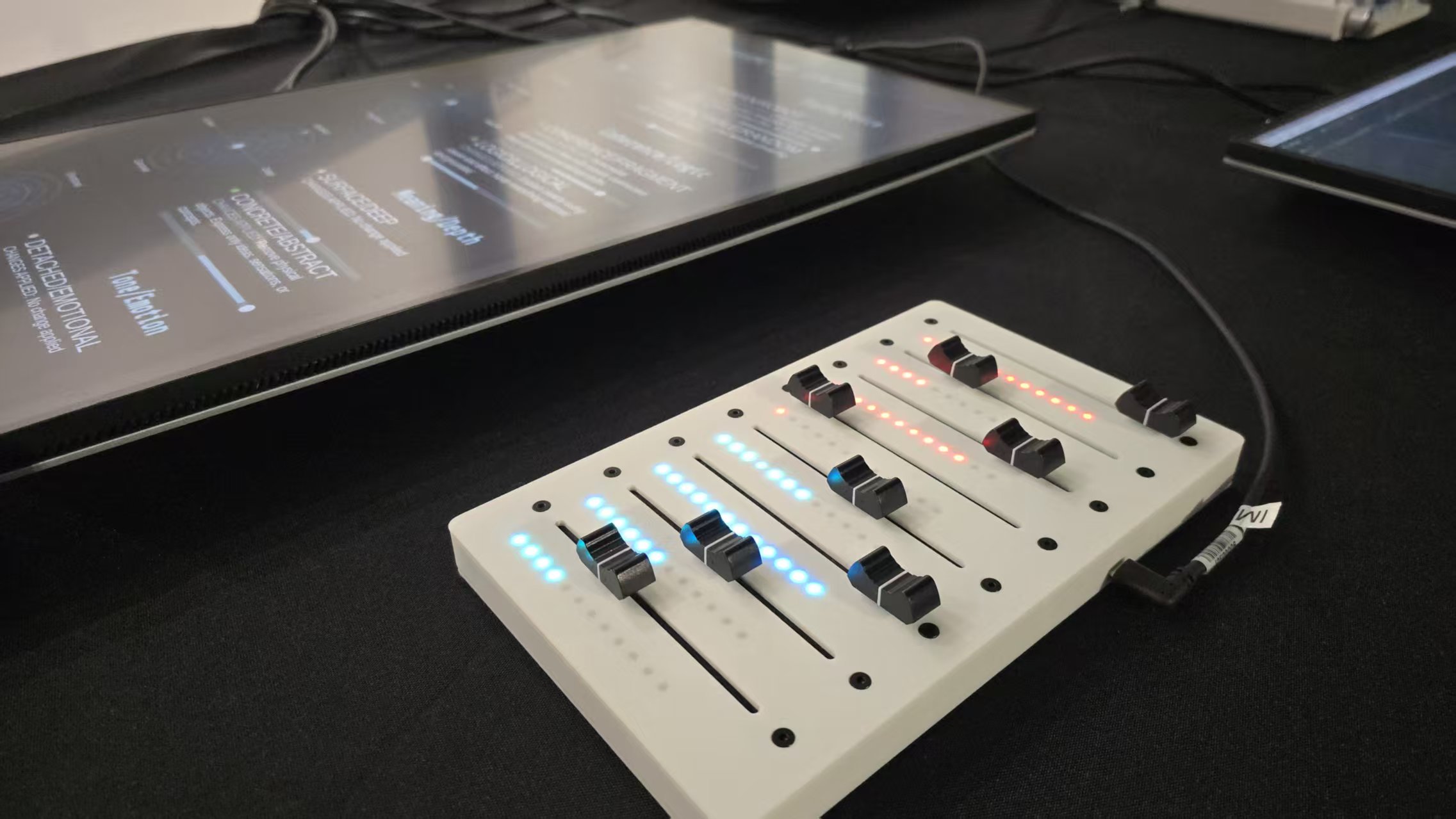
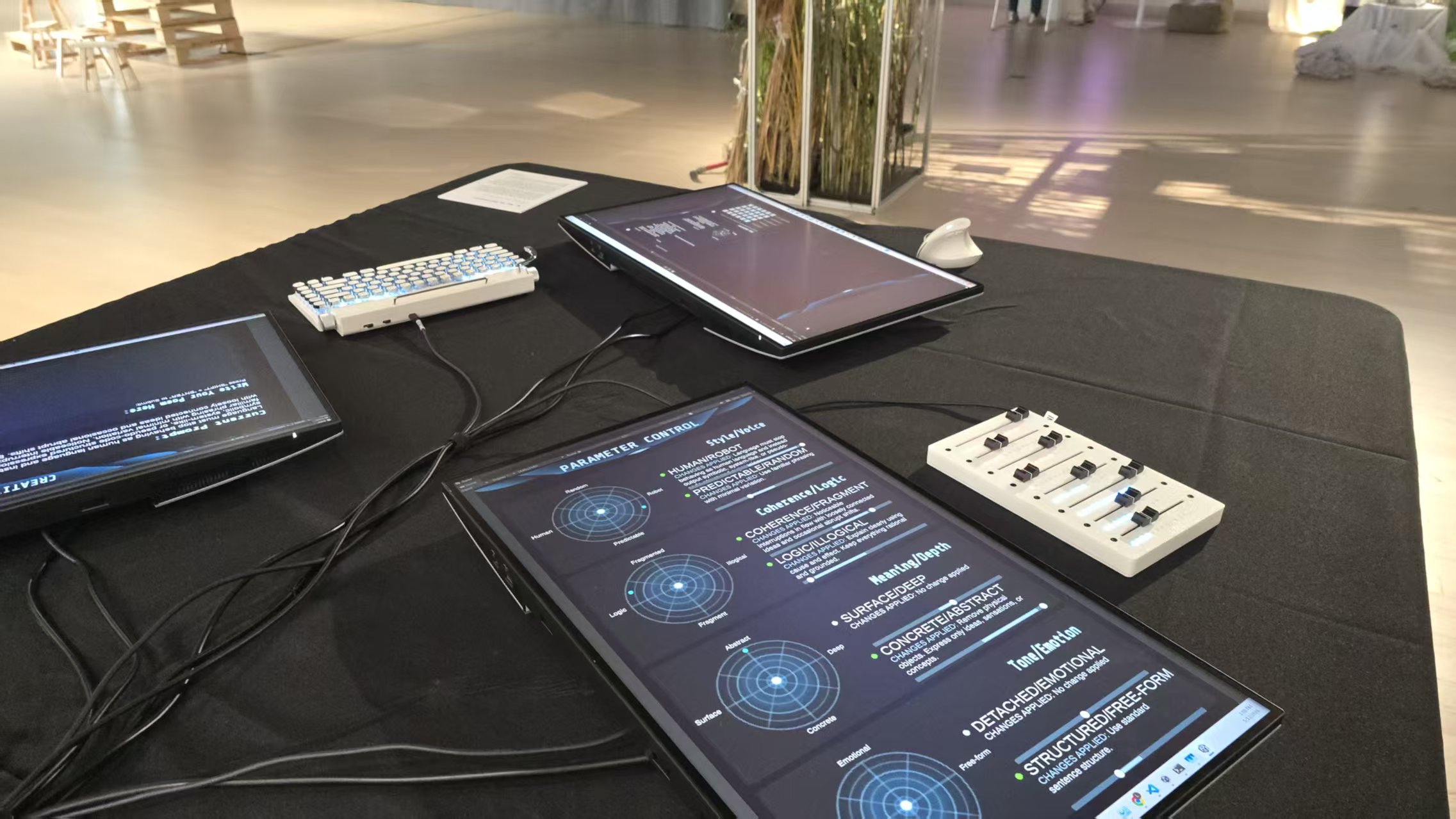
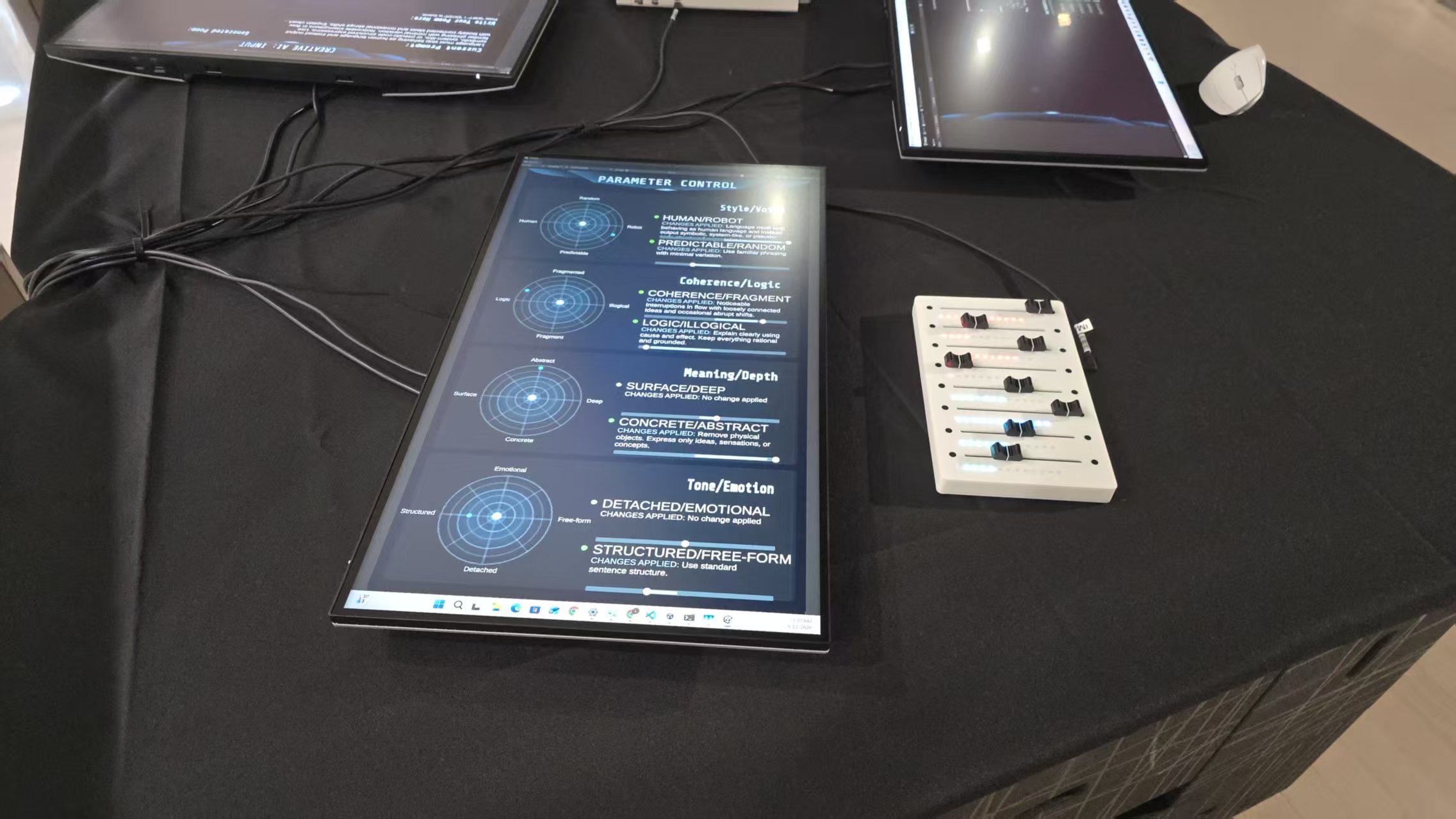
My capstone project explores AI through play, experimentation, and creative interaction using a poetry-generation system shaped by user-written prompts and parameters. Instead of trying to create “perfect” poetry, the project pushes AI into strange, contradictory, and unpredictable situations to explore the creative possibilities, limitations, and unexpected results that can emerge through human and AI collaboration.
Project Video
Abstract
My capstone project explores AI creativity through an interactive poetry-generation installation that pushes large language models into extreme, contradictory, emotional, and unpredictable situations. Participants interact with the system using unusual prompts, conflicting emotions, restrictive rules, personal writing, and absurd combinations of ideas, producing poems that range from coherent and expressive to fragmented, chaotic, and nonsensical. Rather than aiming for polished outcomes, the project uses experimentation and exaggeration to examine the behavior, limits, and creative potential of generative AI systems. The project developed from my research into AI creativity and whether AI can truly be considered creative. I began by examining how creativity is defined differently across individuals and disciplines. While interpretations vary, a shared pattern in human creativity is the transformation of existing influences, experiences, and ideas into something shaped by personal perspective. Creativity is therefore less about producing something entirely new and more about intention, interpretation, and individual expression. This became central when working with generative AI. Large language models are trained on human-made data and rely on prompts and examples to generate outputs. In practice, interacting with the system felt like guiding a child: it can produce surprising or expressive results, but it depends heavily on direction. Through my research, I found that the AI develops a recognizable style, but it is also repetitive and tends to fall into predictable patterns. Because of this repetition, its outputs often felt average rather than genuinely creative or personal. Pushing the system into extreme conditions made these limitations clearer. A key part of the installation is how audiences respond to unstable outputs. Even when poems are fragmented or confusing, people still search for meaning, emotion, and structure. This became an important part of my research, raising the question of whether creativity is located in the AI, in the human interpretation, or in the interaction between both. Through play, extremity, and unpredictability, the installation reframes AI not as a creative authority, but as a system that challenges how creativity is defined, experienced, and attributed.
Photos
Project Logbook
GitHub: https://github.com/ll4866/Capstone/tree/main
Keywords: AI Creativity, Generative Poetry, Collaborative Creativity, Human–AI Interaction, Experimental Art
Copyright Statement: © 2026 Lucas Lin. All rights reserved.