

A Case Study of 'Abnormal' Chinese Censorship
Chinese censorship is known for restricting anything directly against the government. Why were the posts from the ‘lying flat’ movement censored if they contained no mention of the government?
Project Video
Abstract
A ‘lying flat’ movement has taken root in the youth culture that is not necessarily anti-work but against the pressure-filled work environment, as well as social expectations. This movement originally started in response to the 996 culture of working from 9am to 9pm, 6 days a week and the government has pushed the younger generation to work harder and produce more. However, as China’s older population increases and goes to retire, the long-term effects of the one-child policy are finally coming to fruition as the younger generation is made to make up for the rapid lack of workforce with longer working hours to keep up with productivity that China wants. ‘Lying flat’ is a rejection of this involution, as they are pressed too hard, resulting in burnout and wanting for a simpler life. Chinese censorship is often chalked up as anything directly against the government or mentioning the Taiwan or Hong Kong situation. However, the posts from this movement were quick to be censored as they went against the promotion of the economic growth of China and threatens the already slowing birth rate. This project aims to look at what led to this movement and why it ultimately became censored.
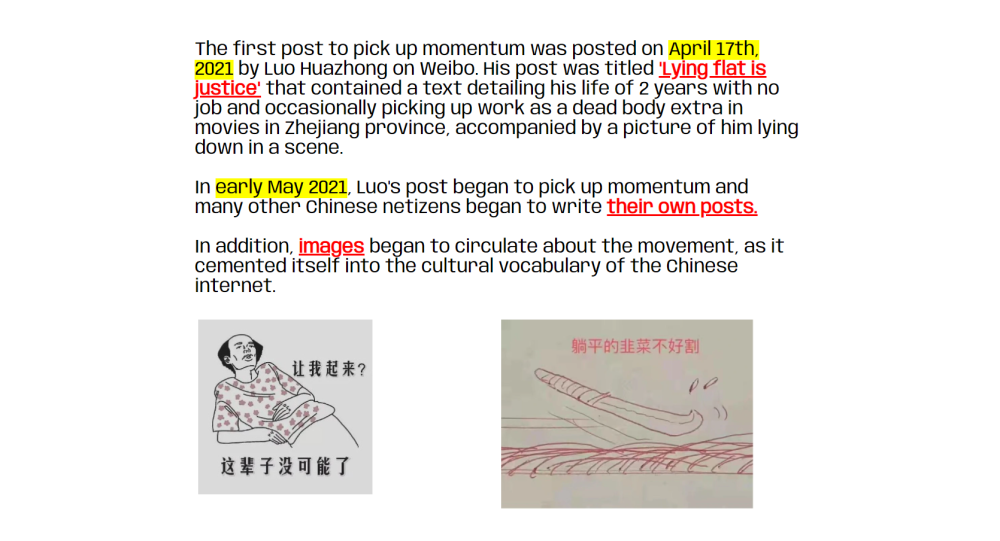
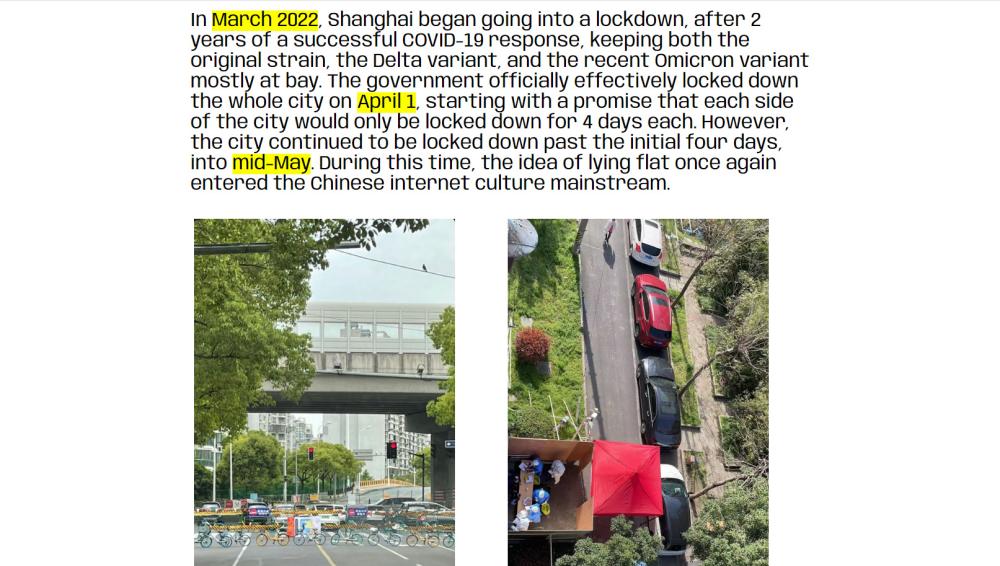
This project is an interactive story that allows users to examine the timeline that emerged through the ‘lying flat’ movement. This project was created for a Western audience because Western media is quick to point out when anti-government things are censored on the Chinese internet, but seem to give no thought to anything else. It focuses on the social media posts of Chinese netizens, as well as media responses from both China and the West. The webpage is set up like an article with links throughout for the user to click on, as well as a scrolling interaction in which sections of the timeline appear. The site is divided into six sections: Introduction, Background Information, ‘Lying Flat’ Goes Viral, ‘Lying Flat’ is Censored by the State, Western Response, and Shanghai Lockdown, The links contain specific media that relate to the time point described in the main portion.
This project addresses this idea of censorship outside the norm, after looking at cases in which slang was used to circumvent the government censors. During research into the type of words that were being censored, I came upon cases that didn’t make immediate sense to me. Cases that didn’t directly relate to the Three T’s (Taiwan, Tiananmen, Tibet) were being censored and I wanted to find out why, as there are no definite reasons for why something would be censored by the Chinese government. This is an important topic to cover because the user gains a better understanding of Chinese internet culture. Beyond me, this project has a more considerable significance because it broadens the typical definition of Chinese censorship for a Western audience.
Photos
Project Link: https://sa4913.github.io/Capstone/
Keywords: Censorship, Internet Culture, Mobile+Web
Copyright Statement: https://drive.google.com/file/d/1BkhxSfoak090337GtAF5h43GgfvnkSRg/view?…